
Choosing timber for an outdoor collection is not simply a question of selecting the most durable species. Buyers must balance appearance, target retail price, product format, finishing system, maintenance expectations, packaging and the climate of the outdoor spaces in which the furniture will be used. This acacia vs eucalyptus vs teak comparison gives importers, retailers and product developers a practical framework for building a clearer sourcing specification.
All three timbers can support successful outdoor programmes when their grade, moisture condition, construction and finish are matched to the intended use. The right choice therefore depends on the programme—not on a universal ranking of wood species.
Acacia vs Eucalyptus vs Teak: the buyer-level comparison
| Decision factor | Acacia | Eucalyptus | Teak |
|---|---|---|---|
| Typical commercial position | Value to mid-market | Value to mid-market | Premium |
| Visual character | Warm colour with noticeable grain variation | Generally even appearance, adaptable to stained finishes | Warm golden-brown appearance that can weather naturally |
| Programme fit | Broad range of dining, seating and occasional furniture | Repeatable volume collections and coordinated sets | Premium collections where material identity is central |
| Finish strategy | Usually benefits from a clearly controlled coating and maintenance plan | Finish specification and process consistency are important | May be sold finished or designed to weather, depending on the buyer brief |
| Buyer watchpoint | Species, grade and colour variation must be agreed | Drying, machining and coating compatibility must be verified | Grade, sourcing evidence and cost exposure require close control |
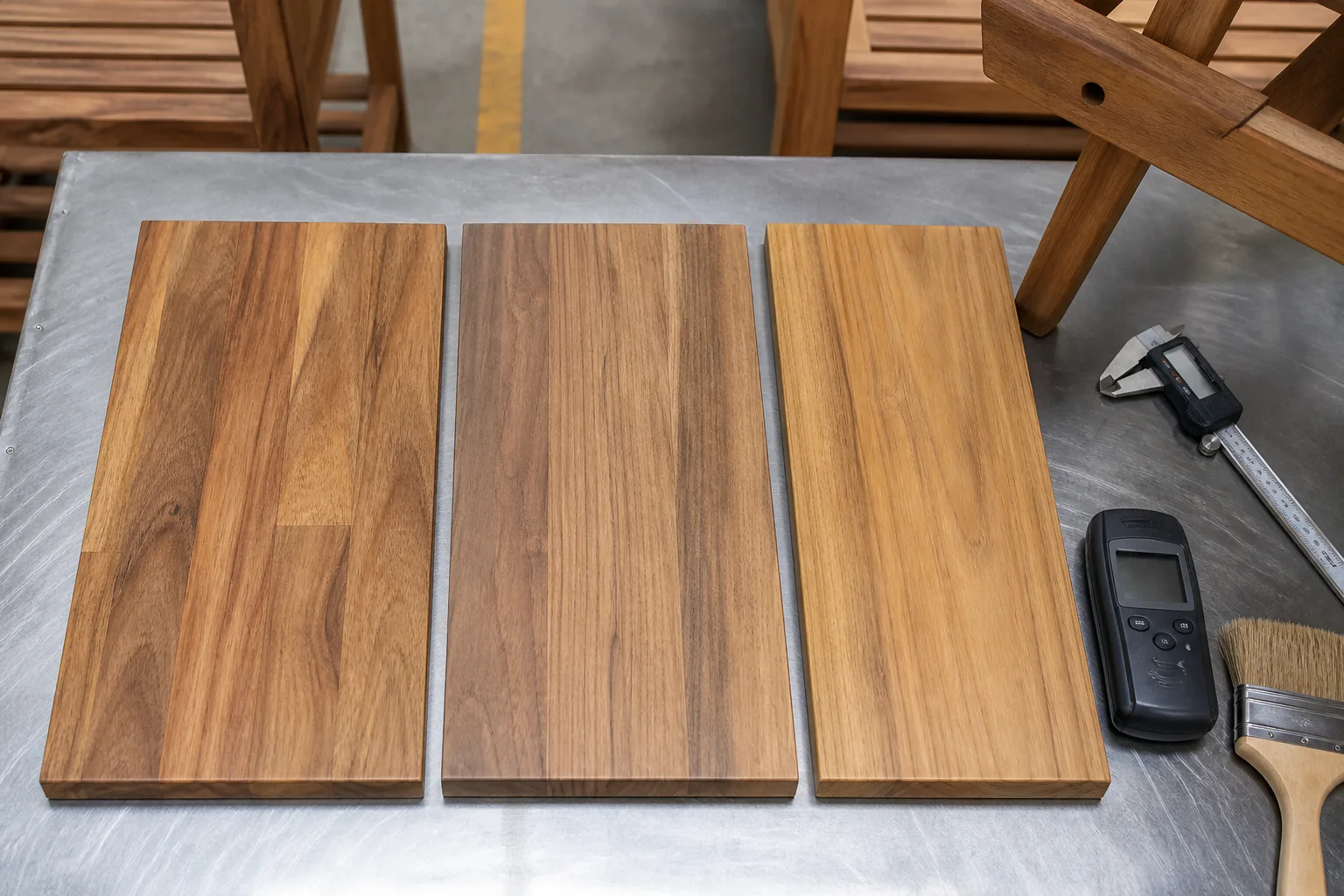
Use this acacia vs eucalyptus vs teak comparison as a commercial starting point rather than a technical acceptance standard. The final specification should define the exact species, grade, component dimensions, moisture requirements, finish system, hardware and test protocol for each SKU.
Acacia: flexible material for broad outdoor collections
Acacia is widely used across outdoor dining sets, benches, loungers and modular seating. Its warm appearance and visible grain can give a collection a natural, substantial character without automatically placing it at the highest retail tier.
For buyers, the word “acacia” alone is not a complete specification. Acacia covers multiple species and commercial grades, so colour, grain, density and machining behaviour may vary. A sourcing brief should identify the botanical or commercially agreed species where relevant, acceptable colour variation, defect limits and the rules for visible versus concealed components.
Acacia can work well in mixed-SKU programmes because it supports both classic and contemporary forms. However, consistency depends on timber selection, drying, component preparation and finish application. Buyers should inspect pre-production samples under the intended finish rather than approving raw wood alone.
When acacia may suit the programme
- The collection needs a natural solid-wood story at an accessible or middle price position.
- Designs include dining, seating and occasional pieces using a coordinated finish.
- The buyer accepts controlled natural variation as part of the product character.
- The supplier can document the agreed species, grade and finishing process.
Eucalyptus: useful for coordinated, repeatable ranges
Eucalyptus is commonly specified for outdoor furniture where buyers want a solid-wood construction, a relatively consistent visual direction and flexibility across coordinated sets. It can be used for dining groups, lounge seating, benches and compact patio products.
The practical buyer question is not whether eucalyptus is “good outdoors” in isolation. It is whether the selected material, drying schedule, joint design and coating system work together for the intended outdoor use and target environment. End-grain sealing, water-shedding details and control around glue lines and fasteners matter as much as the species name on the purchase order.
Eucalyptus can be especially useful when a retailer wants a family of products with repeatable colour and finish. Approval samples should still show the expected production range, not only a single ideal piece. A signed colour panel and written tolerances make production review more objective.
When eucalyptus may suit the programme
- The buyer is developing coordinated outdoor sets across several SKUs.
- Finish consistency and repeatability are central to the merchandising plan.
- The programme requires solid wood while maintaining a value-conscious position.
- The specification includes clear controls for moisture, coating and exposed end grain.
Teak: premium positioning with stricter sourcing decisions
Teak is strongly associated with premium outdoor furniture because of its material reputation, recognizable appearance and ability to support either a finished look or a naturally weathered design direction. That reputation, however, does not remove the need for careful specification.
Buyers should define grade expectations, acceptable colour and grain, rules for sapwood, repair limits and whether components may be laminated. They should also request sourcing documentation appropriate to their market and internal compliance policy. Claims about origin, certification or legality must be supported by current programme-specific records rather than assumed from the species name.
Teak may be commercially appropriate when the material itself is part of the product proposition and the retail price can absorb tighter material selection. It is less suitable when the buyer expects premium-grade appearance but budgets and tolerances are written for a value programme.
When teak may suit the programme
- The collection is intentionally positioned at the premium end of the market.
- The design and merchandising story rely on teak’s recognizable appearance.
- The buyer has defined grade, sourcing evidence and natural-weathering expectations.
- The commercial model can accommodate material-cost and availability changes.
Durability depends on more than the timber name
Species selection is only one layer of outdoor performance. A sound acacia vs eucalyptus vs teak decision should also assess how the furniture is engineered and produced.
Moisture and timber preparation
Moisture targets should reflect the destination market, construction and finishing process. The supplier should explain how timber is conditioned, measured and segregated before machining. Buyers should agree how readings are sampled and recorded during production rather than relying on one result from a finished sample.
Construction and water management
Outdoor designs should avoid unnecessary water traps. Joint orientation, drainage gaps, end-grain exposure, hardware placement and contact points near the ground all influence field performance. A visually attractive sample may still need engineering changes before mass production.
Adhesives, hardware and mixed materials
The adhesive system and metal hardware must be appropriate for the intended exposure and the chosen timber. Buyers should define hardware material or performance requirements, visible finish, replaceability and corrosion expectations. Mixed-material products also require checks for movement, staining and contact between dissimilar materials.
Finish and maintenance communication
A finish should be evaluated as a system: surface preparation, sealer, colour coat, topcoat, curing and repair method. The approved appearance needs measurable or clearly illustrated tolerances. Care instructions must match the actual finish and expected outdoor exposure; they should not promise maintenance-free performance unless it is substantiated.
How to choose wood by programme objective
When applying an acacia vs eucalyptus vs teak comparison, purchasing teams should begin with the programme’s commercial objective instead of asking which wood is universally best.
- Value-led, broad assortment: compare acacia and eucalyptus against the same design, finish and packaging assumptions.
- Coordinated seasonal range: prioritise repeatable colour, component supply and production controls across SKUs.
- Premium material story: assess whether teak grade and sourcing requirements are reflected in the target retail price.
- Low-maintenance expectation: review the complete construction and finish system rather than treating species as a shortcut.
- Compact e-commerce programme: include knock-down engineering, assembly clarity and carton performance in the material decision.
Nghia Son develops solid-wood outdoor furniture in acacia, eucalyptus and teak. A useful supplier discussion should start with the target market, product architecture and required appearance so that material selection supports the whole programme.
Questions to include in an RFQ
A precise RFQ makes an acacia vs eucalyptus vs teak comparison more reliable because suppliers are responding to the same commercial and technical assumptions.
- Which exact species and commercial grade are quoted?
- What natural colour and grain variation should be expected?
- What moisture requirement and verification method will apply?
- Which components are solid, laminated or otherwise engineered?
- How are exposed end grain, drainage and ground-contact details handled?
- What adhesive, hardware and coating systems are proposed?
- Which test requirements are buyer-specified for the destination market?
- What sourcing and chain-of-custody documents are available for review?
- How will the approved colour and workmanship range be controlled in production?
- What care instructions and refinishing guidance will accompany the product?
- How do packaging and assembly design protect the furniture in distribution?
- Which assumptions could change price, yield or production planning?
A practical sample-review sequence
For an acacia vs eucalyptus vs teak review, begin with material and finish panels to narrow colour and coating direction. Move to a complete development sample to review proportions, comfort, joinery and assembly. Before production, approve a control sample together with written tolerances and packaging requirements. During production, inspection should compare workmanship and appearance against those approved references.
For programmes containing several materials, keep the acacia vs eucalyptus vs teak assessment consistent by using the same review structure for each option. That creates a fair comparison and exposes trade-offs before the range is committed.
Frequently asked questions
No. Teak may support a premium material proposition, but the best commercial choice depends on design, grade, budget, finish, maintenance expectation and target market. Well-specified acacia or eucalyptus can be more appropriate for many volume programmes.
Outdoor suitability depends on the complete product system and exposure conditions. Buyers should evaluate timber preparation, construction, coating, hardware, care guidance and product testing for the intended market.
Both can be useful, but a finished control sample is essential because coating changes colour, grain contrast and perceived consistency. Approval should also define the acceptable production range.
Start with a written material and construction specification tied to the exact SKU. Compliance and sourcing documents should then be requested according to the species, destination market and buyer policy.
Build the specification before requesting a final quote
The strongest acacia vs eucalyptus vs teak decision is made after the buyer defines the programme’s market position, appearance, construction, finish, testing, packaging and documentation requirements. A quote based only on dimensions and a wood name leaves too much room for different assumptions.
Share your target product type, destination market, finish direction and required documentation with Nghia Son. Our team can review the brief and help structure a material discussion for your outdoor furniture programme without treating one timber as the universal answer.