
Outdoor furniture quality control should begin before mass production, not when finished cartons are waiting for shipment. A useful QC plan gives the buyer and manufacturer the same reference for timber, dimensions, construction, finish, function and packaging. It also defines when each item will be checked, how non-conformities will be recorded and who approves corrective action.
For importers, retailers and sourcing teams, the objective is not to inspect every characteristic at the final table. It is to place the right control point before a defect becomes expensive to correct or repeats across an entire order.
Outdoor furniture quality control: the buyer’s framework
A practical outdoor furniture quality control process follows the product through five connected stages:
- Define the approval basis: confirm the specification, drawing, material schedule, finish panel, approved sample and packaging brief.
- Check incoming materials: verify timber, hardware, adhesives, finishing materials and packaging components against the agreed requirements.
- Control production: review dimensions, machining, joints, assembly, sanding and finish at stages where correction is still possible.
- Inspect finished goods: compare workmanship, appearance, function and identification with the approved references.
- Verify packing and release: confirm components, instructions, protection, carton markings and shipment records before loading.
The acceptance rules must come from the buyer’s product specification, destination-market requirements and agreed inspection plan. A generic checklist can organise the review, but it cannot replace product-specific testing or compliance work.
1. Establish the inspection basis before production
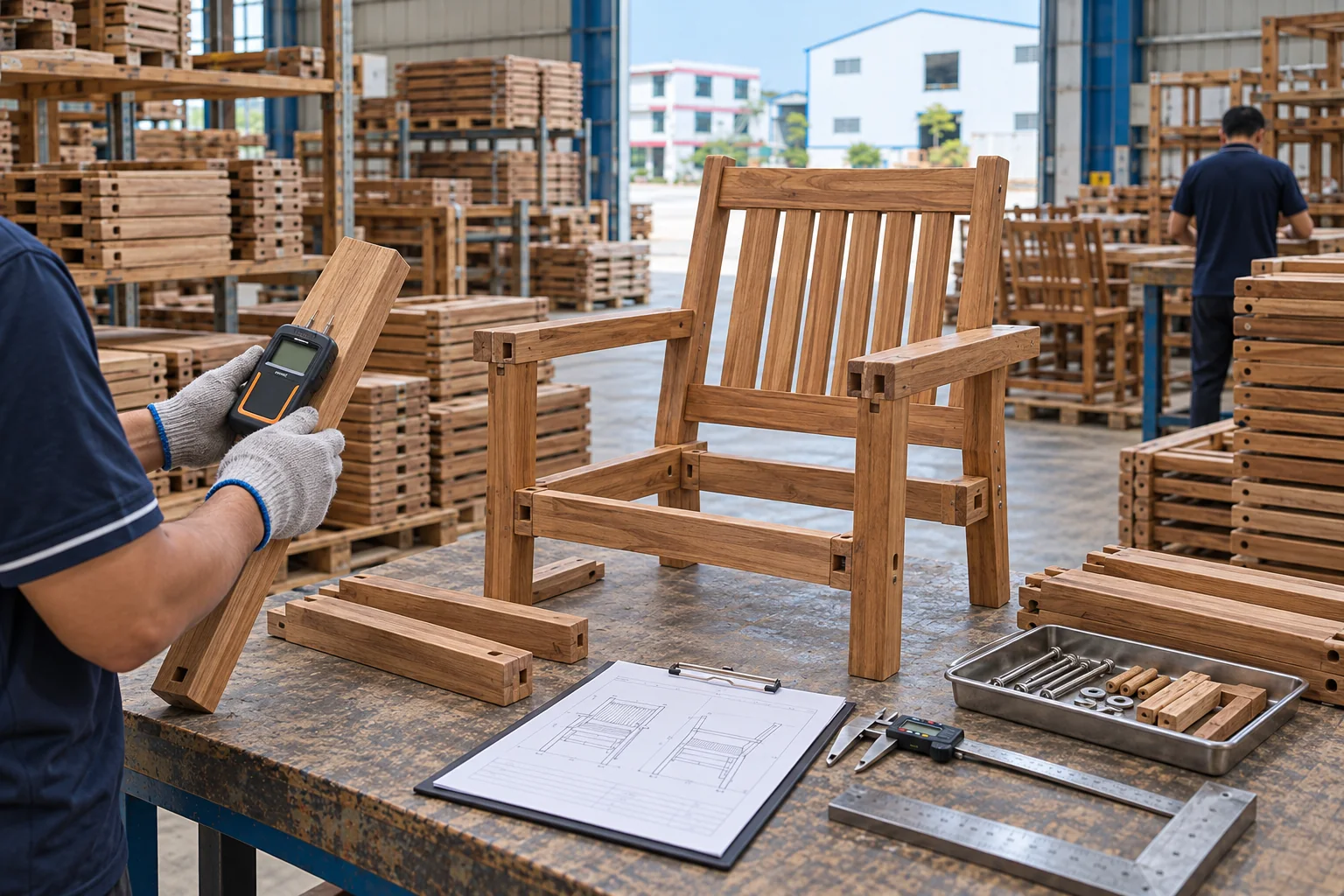
Quality becomes subjective when the purchase order names only a model, dimensions and timber species. Before production, the buyer and manufacturer should agree which documents and samples control the order.
Core approval references
- Product drawing with critical dimensions and tolerances
- Material and component schedule
- Approved colour or finish panel
- Approved development or pre-production sample
- Hardware list and assembly method
- Packaging specification and marking requirements
- Buyer-defined test and inspection requirements
Each reference should have a version or approval date. If the finish panel changes but the drawing and purchase order do not, production teams may work from different assumptions. The same risk appears when an approved sample contains a hardware change that never reaches the written specification.
This control stage is especially important when sourcing from an outdoor furniture manufacturer Vietnam programme involving several SKUs, finishes or packaging formats. One agreed reference set helps purchasing, engineering, production and inspection teams evaluate the same product.
2. Inspect timber and incoming components
In outdoor furniture quality control, incoming inspection should confirm that materials match the order before they are machined, finished or hidden inside an assembly. The exact records depend on the product, but buyers should expect traceable checks for the characteristics that affect appearance, construction and field performance.
Timber identity and condition
For solid-wood outdoor furniture, the agreed species and grade should be identifiable in the material specification. Inspectors can review visible colour and grain range, defects, component suitability and signs of handling or storage damage. Requirements for sapwood, repairs, laminations and visible surfaces should be written rather than left to personal judgement.
Moisture-control planning
Wood exchanges moisture with its environment, so moisture control is connected to dimensional movement, machining, gluing and finishing. A buyer should not copy a universal percentage into every RFQ. The target and sampling approach should reflect the species, component, construction, manufacturing environment and destination conditions.
The inspection plan should identify where readings are taken, what equipment is used, how the instrument is checked and how results are recorded. A small number of convenient surface readings should not be presented as proof for an entire order.
Hardware and purchased parts
Fasteners, brackets, hinges, adjustment mechanisms, glides and other purchased components need their own checks. Review material or finish where specified, dimensions, quantity, fit, visible condition and compatibility with the furniture design. For mixed-material products, the buyer should also consider contact between timber and metal, drainage and the possibility of staining.
3. Control machining, joints and assembly
In-process inspection catches repeatable problems before finish and packing make them harder to correct. The purpose is not only to find defective pieces; it is to verify that the production method continues to match the approved construction.
Dimensions and component preparation
Critical dimensions should be selected from the drawing rather than measuring every feature with equal priority. Inspectors can check component thickness, hole position, alignment, mating parts and assembly clearances. For knock-down furniture, repeated assembly and disassembly of a production sample can reveal fit problems that a visual check misses.
Joinery and structural consistency
Joint type, glue application, fastener position and component orientation should follow the approved construction. Inspect for gaps, splitting, damaged edges, loose connections and interference between moving parts. Drainage details and exposed end grain deserve particular attention in products intended for outdoor use.
First-off and in-process reviews
A first-off review examines one of the first completed units before the same operation repeats across the order. Later in-process checks confirm that corrections were implemented and that workmanship remains consistent. This sequence gives outdoor furniture quality control a preventive role instead of relying only on final sorting.
4. Inspect sanding, colour and finish
Finish approval should cover more than a colour name. Surface preparation, coating sequence, application, curing and handling all influence the final appearance. Buyers should agree an acceptable colour and sheen range using physical references under consistent lighting.
Inspection points may include:
- Sanding marks, torn grain and sharp or rough edges
- Colour consistency within the agreed natural range
- Coverage around joints, end grain and difficult-to-reach areas
- Runs, dust, pinholes, contamination or handling damage
- Adhesion or performance checks specifically required by the buyer
- Repair appearance and the rules for rework
Natural variation should not become an excuse for uncontrolled variation. The outdoor furniture wood comparison should inform the finish brief because acacia, eucalyptus and teak can present different colour and grain characteristics. Production samples should demonstrate the range the buyer will actually receive.
5. Verify function and finished-product workmanship
The finished-goods stage of outdoor furniture quality control compares production with the approved sample and specification. The review should cover identity, completeness, appearance, dimensions, stability and intended functions.
Product identification and completeness
Confirm model, size, finish, component set, hardware pack, labels and instructions. Mixed-SKU orders require especially clear separation because similar cartons or components can be exchanged during packing.
Assembly and operation
Assemble a defined sample using the supplied hardware and instructions. Check that parts fit without unauthorised modification, hardware can be tightened correctly and moving features operate as intended. Folding, reclining, extension or locking mechanisms should be reviewed against the approved design.
Workmanship and user-contact surfaces
Inspect visible surfaces, edges, corners, accessible fasteners and contact points. Look for splinters, sharp edges, exposed points, loose parts, uneven feet or other conditions outside the agreed workmanship standard. Product-specific safety and performance testing remains a separate requirement where applicable.
A strong outdoor furniture quality control record distinguishes observation from acceptance. Photographs, item references, quantities and locations help the buyer understand whether an issue is isolated or systematic.
6. Check packaging before shipment release
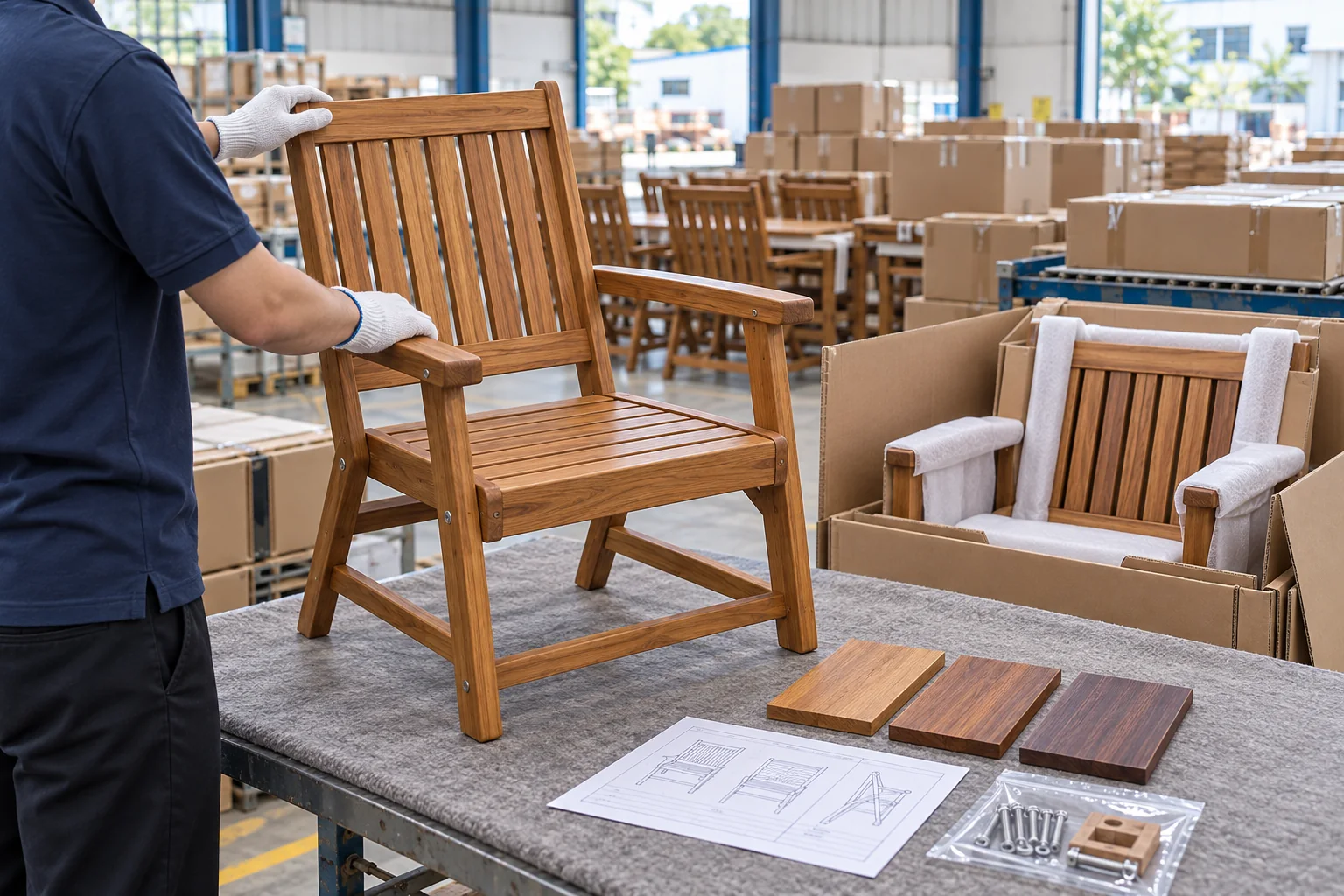
Packaging is part of product quality because a correctly manufactured item can still arrive damaged or incomplete. The packing review should use the approved packaging specification, not only a closed-carton appearance.
Protection and component control
Verify contact protection, corner and edge protection, hardware containment, component separation and the packing sequence. Surfaces that can rub during transport require attention. The buyer should also confirm that loose parts and instructions are present and identifiable.
Carton, markings and assembly information
Check carton dimensions and construction against the approved brief, along with model identification, quantity, handling marks, labels and barcodes where required. Assembly instructions should match the shipped product and hardware set. Private-label elements require their own approved artwork and version control.
Shipment release documentation
The release record should identify the order, inspected quantity or sample, references used, findings, corrective actions and final disposition. If a third-party inspection is required, its scope and timing should be agreed early enough to allow correction—not scheduled only after the loading date is fixed.
What buyers should request in a QC file
The documentation package should be proportionate to the product and programme. A buyer may request:
- Current approved drawing and specification
- Material and hardware schedule
- Approved finish reference
- Sample approval or change record
- Incoming and in-process inspection records relevant to the order
- Finished-product inspection report with photographs
- Buyer-required test reports or declarations, where applicable
- Packaging approval and packing verification
- Corrective-action record for material non-conformities
- Shipment-release decision and responsible approver
Do not treat the quantity of documents as proof of control. Useful records connect a requirement to a product, inspection result, decision and follow-up action.
Common QC mistakes in outdoor furniture sourcing
Waiting for final inspection
A final inspection can identify a repeated colour or drilling problem, but it cannot recover the time already spent producing and packing the order. Earlier control points reduce the cost of correction.
Using an attractive sample without written tolerances
One ideal sample does not show the acceptable production range. Drawings, finish panels and written workmanship criteria make approval more repeatable.
Copying generic thresholds into every order
Moisture, sampling, test and acceptance requirements should be selected for the actual product and market. Unsupported numbers create the appearance of precision without a sound inspection basis.
Separating packaging from product development
Packaging decisions affect hardware placement, knock-down design, assembly instructions and distribution damage. Review packaging while the product can still be adjusted.
Frequently asked questions
It should begin when the buyer and manufacturer define the product specification, approved sample, finish and packaging requirements. Incoming, first-off and in-process checks then prevent repeated errors before the final inspection.
No. It is an important release check, but it cannot replace material approval, production control, product-specific testing or early corrective action. Its value depends on having clear references and acceptance rules.
Buyers should agree the target, sampling method, measurement locations, equipment and record format for the specific species, construction and destination. A universal number should not be assumed for every programme.
No. A checklist organises manufacturing and inspection controls. Applicable safety, performance, chemical or market-compliance testing must be defined separately for the product and destination.
Record the product or component, observation, quantity, location and photographic evidence. Classify and accept defects according to rules agreed before inspection, then document corrective action and closure.
Build quality into the sourcing brief
Outdoor furniture quality control works best when the buyer defines the reference, control point and decision rule before production begins. Timber, construction, finish, function and packaging should form one connected approval process.
Nghia Son supports solid-wood outdoor furniture programmes in acacia, eucalyptus and teak. Share the product drawing, finish direction, destination market and buyer-required inspection scope so the team can review the brief before sampling and quotation.