
Water hyacinth export Vietnam has grown into a significant share of the country’s handicraft trade, but the raw material behind it is becoming harder to secure. Alongside water hyacinth, reed grass is now being chosen by handicraft enterprises as a production material, with the potential to create stable livelihoods for people in the Mekong Delta and earn thousands of billions of VND.
Water Hyacinth Export Vietnam Meets a 9 Billion USD Alternative
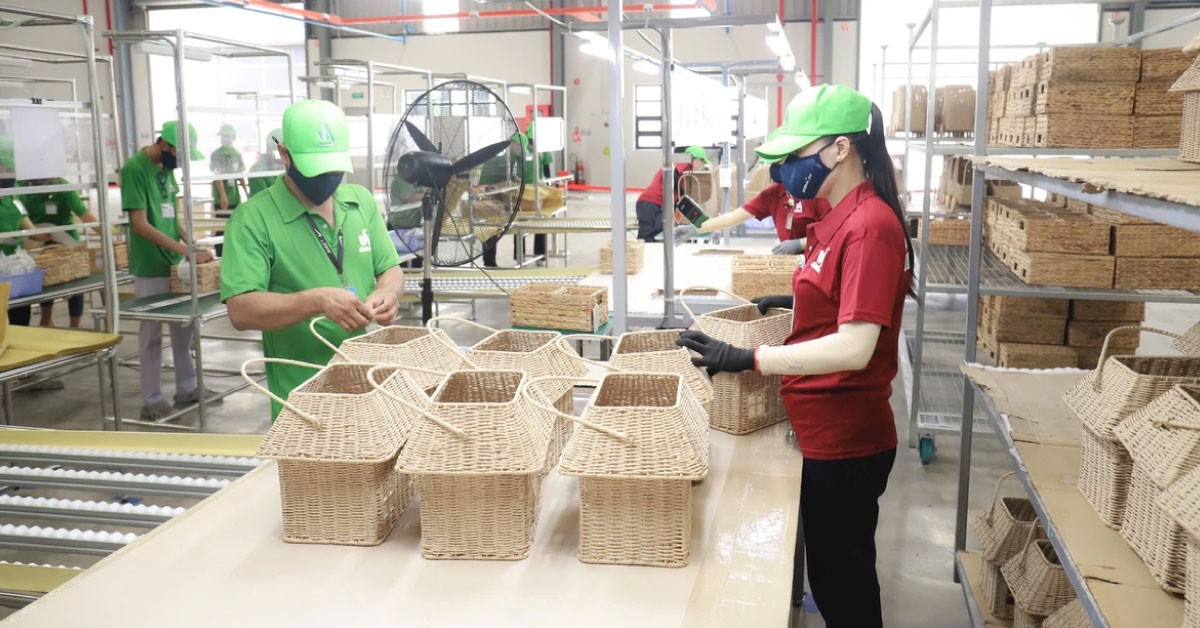
Workers work in the factory of Vietnam Housewares in Vinh Long (HAWA) – Photo: HAWA
After more than 20 years in the wood industry, Mr. Tran Lam Son – General Director of Thien Minh Company – is seeing new opportunities from reed grass after survey trips in the Mekong Delta and meetings with experts.
He said, according to Dr. Tran Van Ni and a research team from Can Tho University, there are currently about 1.8 million hectares of saline land that cannot be cultivated, while the grass is very suitable for this soil.
This is a potential source of raw materials for handicraft and fine art production if it can be replicated. Mr. Son’s daughter has also just started selling woven products from the grass on Amazon, which has initially received a positive reception from the market.
“On an area of 1m2, I once cut 10kg of reed grass, if multiplied by 1.8 million hectares, it will be about 18 million tons. Water hyacinth costs about 24,000 VND/kg. If we can reduce the price of reed grass to half of the expected price, we can earn 9 billion USD” – Mr. Son did a quick calculation.
In the chain of organizing raw material sources and linking product manufacturers, Vietnam Housewares is considered by businesses in the industry as one of the few leading companies in exporting products made from reed grass to the US, Europe, Australia and other markets.
There are many types of raw materials used in handicraft production such as sedge, water hyacinth, cattail and banana fibre. Mr. Lai Tri Moc – General Director of Vietnam Housewares – said that sedge is concentrated in Thanh Hoa and Vinh Long provinces but is only suitable for small-scale production. Banana fibre is not popular yet, and water hyacinth depends on the weather and cannot withstand drought and salinity.
Before the pandemic, demand for bamboo and rattan products was high, so this company had to “beg to buy water hyacinth, which was sometimes harder to buy than gold”. After a long time of searching and cooperating with experts at Can Tho University, and about five years of testing, they assessed that reed grass could replace water hyacinth.
Mr. Moc hopes to reduce the price of reed grass to less than half that of water hyacinth to increase competitive advantage, expand the planting area with local farmers and purchase stable output.
Vietnam Housewares currently has three factories producing wooden, ceramic and handicraft products, including the bamboo and rattan factory in Vinh Long. Most of the company’s products are exported to markets such as the US and EU, through the Walmart, Kmart and Maisons Du Monde systems.
Cheap Raw Materials Create Better Competitive Opportunities
At a recent event organized by the Ho Chi Minh City Handicraft and Wood Processing Association (HAWA), Mr. Huynh Le Dai Thang, director of Nghia Son Furniture Company Limited, said that the company is looking for handicraft manufacturers to export to potential markets such as the US and EU.
He estimated that raw materials account for about half of the production cost in the industry. If the price of raw materials can be reduced by half, Made in Vietnam goods will be very competitive.
“The demand for this industry is huge, but water hyacinth products are prone to mould and odour. Customers often require strict chemical safety requirements, and Amazon often mentions this,” Mr. Thang shared.
Related reading
- Boosting Exports To Global Distribution Chains
- Survival strategy of export enterprises
- Nghia Son Furniture Amid Opportunities and Challenges as Vietnam’s Wood Industry Targets $18.5 Billion in Exports
- Nghia Son Aligns Strategy at Kick-off Business Plan 2026
- Wood industry seeks solutions to maintain US market
- Nghia Son Furniture and a Value-Driven Strategy Beyond Low-Cost Competition in Vietnam’s Wood Furniture Industry
Regarding raw materials, a representative of a Danish buyer said that demand for handicraft products, especially from sedge and water hyacinth, has increased in recent years. However, they face challenges during the rainy season when raw materials are not carefully processed and are susceptible to termites.
Mr. Moc assessed that water hyacinth no longer grows naturally in sufficient volume and may need to be fertilised to grow quickly. This makes the bark of the stem more porous and susceptible to damage after a few weeks of storage.
In contrast, reed grass is a plant that lives in brackish water, and its stem is harder and more durable.
“We wash the stems with ultrasonic waves, dry them, bundle them up, pile them up, and cover them with tarps so that they won’t spoil after a year,” Mr. Moc said.
Why the Material Shift Matters for Water Hyacinth Export Vietnam Buyers
For overseas buyers, the shift is not only about price. The two materials behave differently once a container has spent weeks at sea. Water hyacinth that was fertilised to grow quickly arrives with a more porous stem, which is where mould, odour and termite damage begin. Reed grass, harvested from brackish water, holds its structure longer under the same conditions.
That difference reaches the specification sheet. Chemical safety limits, moisture content and mould resistance are exactly the clauses that marketplace buyers such as Amazon enforce, and they are the clauses that a weaker fibre fails first. Any supplier quoting on water hyacinth export Vietnam volumes should therefore be asked which fibre the quotation assumes, because the two carry different rejection risks on arrival. Developing the handicraft industry from reed grass is expected to be a positive solution both for product consistency and for stabilising the lives of many people in the Mekong Delta.
Frequently Asked Questions
Water hyacinth supply depends on weather and cannot withstand drought or salinity, and stock that has been fertilised to grow quickly develops a porous stem that spoils in storage. Reed grass grows in brackish water, has a harder and more durable stem, and suits the roughly 1.8 million hectares of saline land that cannot otherwise be cultivated.
It is a calculation by Mr. Tran Lam Son of Thien Minh Company: about 10kg of reed grass cut per square metre across 1.8 million hectares gives roughly 18 million tons. Against a water hyacinth price of about 24,000 VND/kg, halving that price for reed grass produces the 9 billion USD estimate.
Mould and odour are the most common. Buyers apply strict chemical safety requirements, and marketplaces such as Amazon enforce them. Damage from termites also rises when raw materials are harvested in the rainy season and not carefully processed before weaving.
Mainly the US, Europe and Australia. Vietnam Housewares reaches them through retail systems including Walmart, Kmart and Maisons Du Monde, while Nghia Son Furniture is seeking handicraft manufacturers to supply the US and EU.
Source: tuoitre.vn