
Whether wood products reciprocal tariffs actually apply to furniture is still unresolved. US President Donald Trump has announced a 46% reciprocal tax on goods from Vietnam, raising concerns for export industries including wood and wood products. However, according to a representative of the Handicraft and Wood Processing Association of Ho Chi Minh City (HAWA), there is still no detailed information on each item, and it is possible that wood products have not been taxed.
HAWA’s Reading of the Wood Products Reciprocal Tariffs
Speaking with the writer, Mr. Huynh Le Dai Thang, Member of the Executive Committee of HAWA, said the 46% rate is a general ceiling, not a figure determined specifically for each type of product.
“Currently, we still do not know exactly how much tax wood products will be subject to, and it is even possible that wood products have not been taxed. Therefore, we need to wait for more official information from the US before being able to make a specific assessment,” Mr. Thang said.
The distinction matters commercially. A headline country rate and a product-line rate are different instruments, and until the tariff schedule is published at HS code level, exporters cannot price contracts, quote lead times or decide whether to accelerate shipments. That uncertainty, rather than the 46% figure itself, is what stalls order confirmation on both sides of a deal.
Why the US Market Weight Makes This Urgent
The US is an important export market for the Vietnamese wood industry. In 2024, export turnover of wood and wood products to the US reached more than 9 billion USD, an increase of 24% compared with the previous year, accounting for more than 50% of total furniture export volume.
In the context of reciprocal tariffs, many businesses in the industry are worried about facing difficulties, but HAWA said they have prepared in advance. At that concentration, wood products reciprocal tariffs would reprice more than half the industry’s output at once rather than trimming a marginal channel.
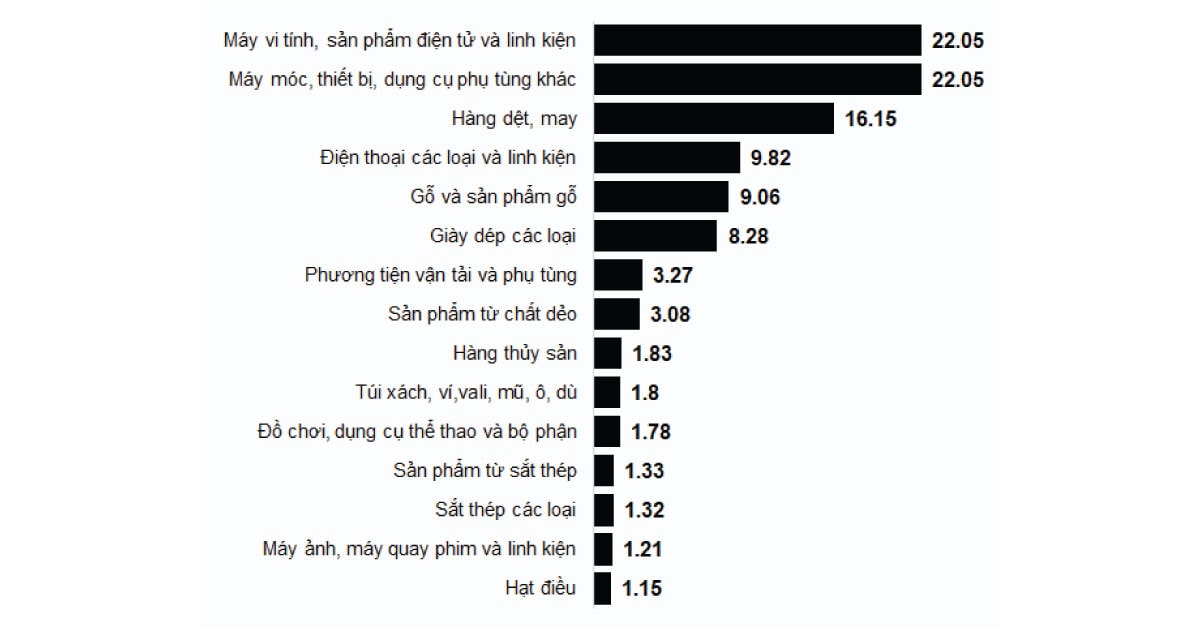
Vietnam’s main export items to the US in 2024, unit: billion USD. Source: Customs Department, Vietstock synthesis
The Zero-Tariff Move on American Timber
“The HAWA Executive Board sent a petition to the Government more than a month ago. Just 3 days ago, the Government issued a Decree to reduce import tax on raw wood and finished wood products imported from the US to 0%,” Mr. Thang shared, assessing this as a positive move that gives Vietnam an advantage in negotiations.
The logic behind the decree is reciprocity made visible. Reciprocal tariffs are calculated against a trade imbalance, so lowering the barrier on American timber entering Vietnam reduces the imbalance the tariff is meant to correct. It also gives Vietnamese manufacturers a cheaper route to US-origin raw material, which can lower the dutiable value of the finished goods they ship back.
Related reading
- Nghia Son Furniture Amid Opportunities and Challenges as Vietnam’s Wood Industry Targets $18.5 Billion in Exports
- Exports to the US are optimistic but the risk of being imposed with penalties is also higher
- Nghia Son Furniture and Its Direct-to-Consumer Strategy for Exporting Wooden Furniture to the U.S. Market
- Wood industry seeks solutions to maintain US market
- The Trump administration is “scrutinizing” the origin of goods, what should wood businesses do?
Negotiation and Government Response
Although the US has announced the new rate, there is still about a week for the countries involved to negotiate with the US Department of Commerce. According to the HAWA representative, the Vietnamese Government has sent a high-level delegation to the US for negotiations. He hopes that with the tax exemption policy for wood imports from the US, Vietnam will hold more advantages in the talks.
On the morning of 3 April, Prime Minister Pham Minh Chinh chaired a meeting with ministries and branches to assess the situation and discuss solutions. The Prime Minister emphasised that trade competition is becoming increasingly complicated and unpredictable. He affirmed that Vietnam has implemented many solutions in response, and that the US imposition of tax is not suitable for the relationship between the two countries.
The Prime Minister asked ministries and branches to maintain composure and adopt flexible, effective policies. The Government will establish a rapid response team headed by Deputy Prime Minister Bui Thanh Son to closely monitor the situation. Deputy Prime Minister Ho Duc Phoc was assigned to listen to opinions from businesses, including large export enterprises, to find suitable solutions.
What Exporters Can Do While the Rate Is Unknown
Waiting is not the same as doing nothing. Three preparations hold their value whichever way the schedule lands.
The first is contract language: purchase orders agreed now should say explicitly who carries a tariff introduced between order and delivery, because that clause decides who absorbs the cost if wood products reciprocal tariffs are confirmed mid-shipment. The second is origin documentation, since any relief tied to US-originating content requires proof at the border rather than an assertion afterwards. The third is buyer communication, because an importer who hears a realistic scenario from a supplier is more likely to hold the relationship than one who hears nothing until the invoice changes.
Frequently Asked Questions
No. The 46% figure is a general country ceiling for goods from Vietnam, not a rate set per product line. HAWA’s position is that the applicable rate for wood products is not yet known, and that they may not have been taxed at all.
Heavily. Exports of wood and wood products to the US reached more than 9 billion USD in 2024, up 24% year on year, and represented more than half of total furniture export volume.
It issued a Decree reducing import tax on raw wood and finished wood products from the US to 0%, following a HAWA petition, and sent a high-level delegation to negotiate with the US Department of Commerce. A rapid response team was established under Deputy Prime Minister Bui Thanh Son.
Fix tariff-change responsibility in purchase order terms, keep origin documentation ready to evidence any US-content relief, and keep buyers informed rather than waiting for the schedule to be published.
Source: vietstock.vn